What an IMEI actually tells you
Fifteen digits, three parts, one of them a checksum. What the number encodes, what it doesn't, and where people read too much into it.
An IMEI — International Mobile Equipment Identity — is the serial number of a piece of radio hardware. Not of a phone number, not of a SIM, not of a person. It is stamped into the device at manufacture and travels with the hardware for the rest of its life, through every owner, every SIM swap and every factory reset.
You can see yours by dialling *#06# on the keypad. It is also printed on the SIM tray of most phones, on the original box, and in the settings under the device information screen.
The three parts
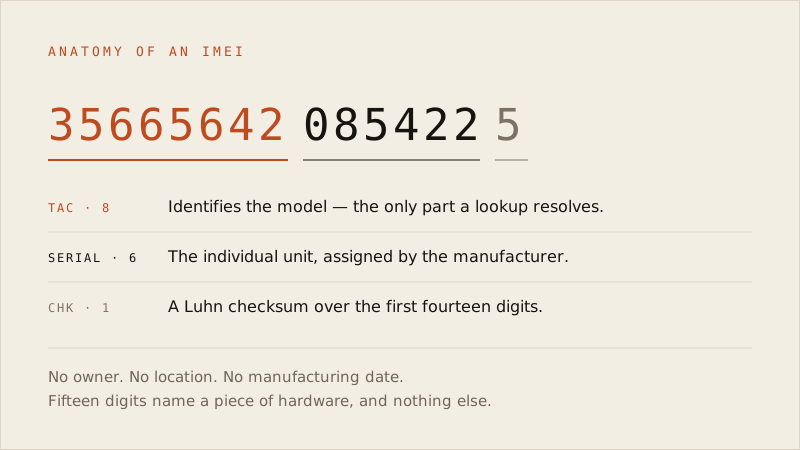
Fifteen digits, and they are not one continuous number. They split into three fields, each with a different job:
| Field | Digits | What it is |
|---|---|---|
| TAC | 1–8 | Type Allocation Code — identifies the model |
| Serial | 9–14 | The individual unit, assigned by the manufacturer |
| Check | 15 | A Luhn checksum over the first fourteen |
Only the first eight digits carry information anyone outside the manufacturer can act on. The TAC is what a lookup resolves: give it 35665642 and a register can tell you the make, the model and the hardware profile. The middle six digits are the manufacturer's own serial counter — meaningful to them, opaque to everyone else. The final digit is arithmetic.
Why the last digit exists
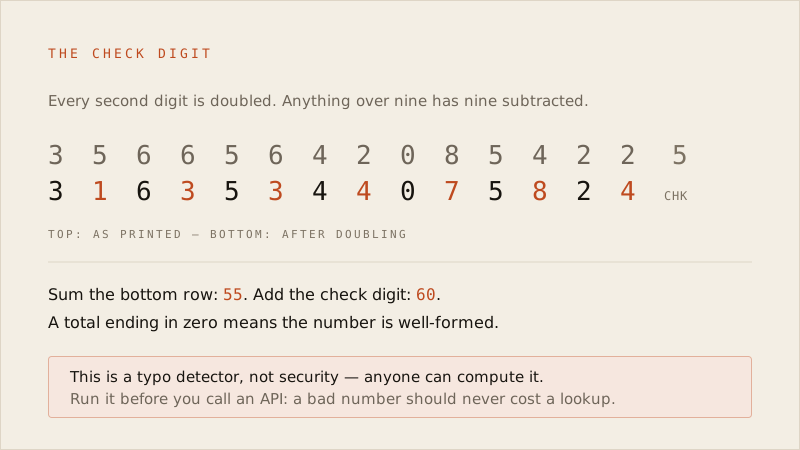
The fifteenth digit is a Luhn check digit, the same scheme used on payment cards. It is not security — anyone can compute it — it is a typo detector. Transpose two digits while copying an IMEI off a box and the checksum almost certainly fails, which is exactly the point.
What the number does not tell you
The IMEI is widely over-read. It is worth being precise about the limits, because a lot of bad product decisions start with assuming the number knows more than it does.
- It does not encode the owner. There is no name, no account, no phone number in those fifteen digits.
- It does not encode location. An IMEI cannot be geolocated by itself; what can be located is a device that is currently attached to a network, and that is a carrier operation, not a lookup.
- It does not encode the manufacturing date. The TAC is allocated when a model is registered, which is not the same as when your particular unit left the line.
- It does not encode the storage size, the colour, or the SIM configuration — those vary within a single TAC on many models.
- It does not prove the device is legitimate. An IMEI can be cloned or reflashed; a well-formed number is a claim, not a certificate.
Variants you will meet
A few relatives of the IMEI turn up often enough to be worth recognising:
- IMEISV — sixteen digits. Same TAC and serial, but the check digit is replaced by a two-digit software version. Handy for firmware fleets, useless as a checksum.
- Dual-SIM devices carry two IMEIs, one per radio. Both are valid, both resolve to the same model, and intake systems that assume one identifier per device get confused by exactly this.
- Devices with no cellular radio have no IMEI at all — a Wi-Fi-only tablet has a serial number and nothing more.
Where the structure came from
The eight-digit TAC is a relatively recent shape. Older IMEIs split the same eight digits into a six-digit type approval code and a two-digit final assembly code identifying the factory. That split was abandoned in the mid-2000s and the whole eight digits became a single allocation. You will still occasionally meet documentation describing the old layout; it is describing a scheme that no longer applies.
The practical consequence: never parse an IMEI by slicing it into more pieces than TAC, serial and check. The internal structure of the TAC is not yours to interpret, and it has changed before.
Read next
Turn an IMEI into a device record.
Brand, model, code name, device type and radio bands, in one call. Tell us what you're building and we'll set you up with a key.