MEID and IMEI: when you still meet the other one
Two identifier schemes from two network families. What actually differs, and what to do when a device hands you fourteen hex characters instead of fifteen digits.
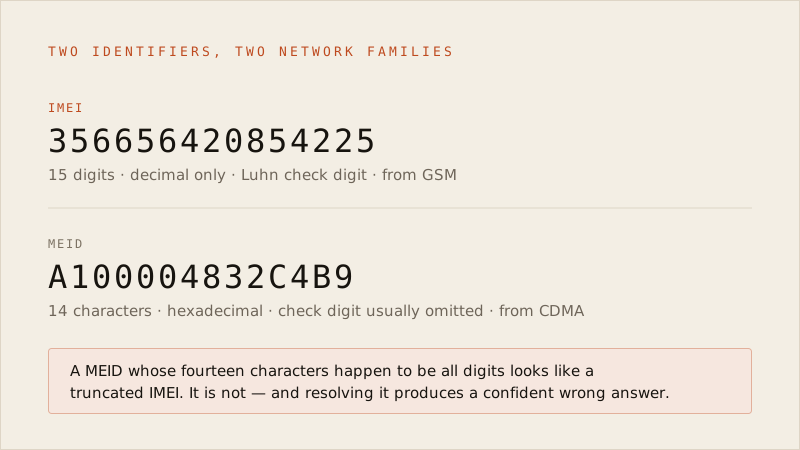
IMEI and MEID solve the same problem — naming a piece of radio hardware — but they came out of different network families, and the difference is still visible in intake systems today.
| IMEI | MEID | |
|---|---|---|
| Length | 15 digits | 14 characters |
| Alphabet | Decimal only | Hexadecimal (0–9, A–F) |
| Origin | GSM and its successors | CDMA |
| Check digit | Yes, Luhn | Optional, usually omitted |
| Structure | TAC + serial + check | Manufacturer code + serial |
Why two schemes existed
IMEI came from the GSM world, which dominated most of the planet. MEID came from CDMA, which held significant share in North America and parts of Asia, and replaced the older 32-bit ESN when that ran out of space. For years a device could carry one, the other, or both, depending on which radios it contained.
CDMA networks have since been shut down in most markets, so new hardware is IMEI-only. What has not gone away is the installed base and the paperwork: devices from that era still circulate through resale and repair, and records created in that era still sit in databases.
Where you actually hit this
In practice, a modern intake system meets MEID in three situations:
- Older stock. A device from the dual-technology era can report a MEID, an IMEI, or both, depending on what you ask it for.
- Legacy records. Inventory systems, insurance files and old sales records hold MEIDs entered years ago and never migrated.
- Users copying the wrong field. Device information screens on older hardware list several identifiers, and people copy whichever one they see first.
The hex trap
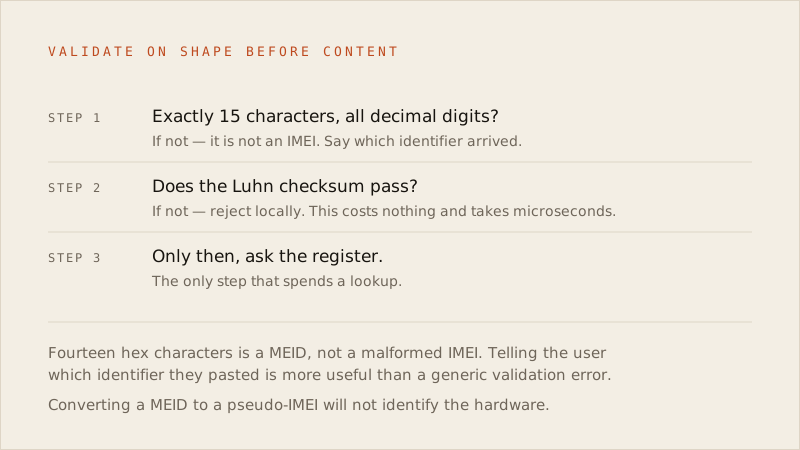
The failure mode worth knowing about: a MEID whose fourteen characters happen to all be digits. It looks like a truncated IMEI. It is not — it is a different identifier in a different numbering space, and treating it as an IMEI produces a confident, wrong answer.
The pMEID conversion, and why to be careful
There is a documented mapping that produces a pseudo-IMEI from a MEID, and reference implementations of it are easy to find. It is genuinely useful in narrow contexts — mostly network-side provisioning.
It is a poor fit for device identification. The result is a synthesised number, not the identifier the manufacturer registered, so resolving it against a TAC register will not tell you what the device is. If your goal is "what hardware am I holding", a converted MEID is a dead end; ask the device for its IMEI instead.
Practical guidance
- Accept both at the edge of your system, and label which one you received. Silently normalising them into one field loses information you will want later.
- Do lookups on IMEI only, and say so plainly in your interface when a MEID arrives, rather than failing with a generic validation error.
- For anything from before the CDMA shutdowns, expect the identifier on file to be whichever one the operator of the day happened to record — and expect it to be inconsistent across records for the same device.
Read next
Turn an IMEI into a device record.
Brand, model, code name, device type and radio bands, in one call. Tell us what you're building and we'll set you up with a key.